Computational prediction of proximal sealing in EVAR with unfavorable necks

Objective
Endovascular aortic aneurysm repair (EVAR) has become the standard treatment for abdominal aortic aneurysms in most centers.
However, proximal sealing complications leading to endoleaks and migrations sometimes occur, particularly in unfavorable aortic anatomies and are strongly dependent on biomechanical interactions between the aortic wall and the endograft.
The objective of the present work is to develop and validate a computational patient-specific model that can accurately predict these complications.
Methods
Based on pre-operative CT-scans, we developed finite element models of the aorta of 10 patients who underwent endovascular aortic aneurysm repair, 7 with standard morphologies and 3 with unfavorable anatomies.
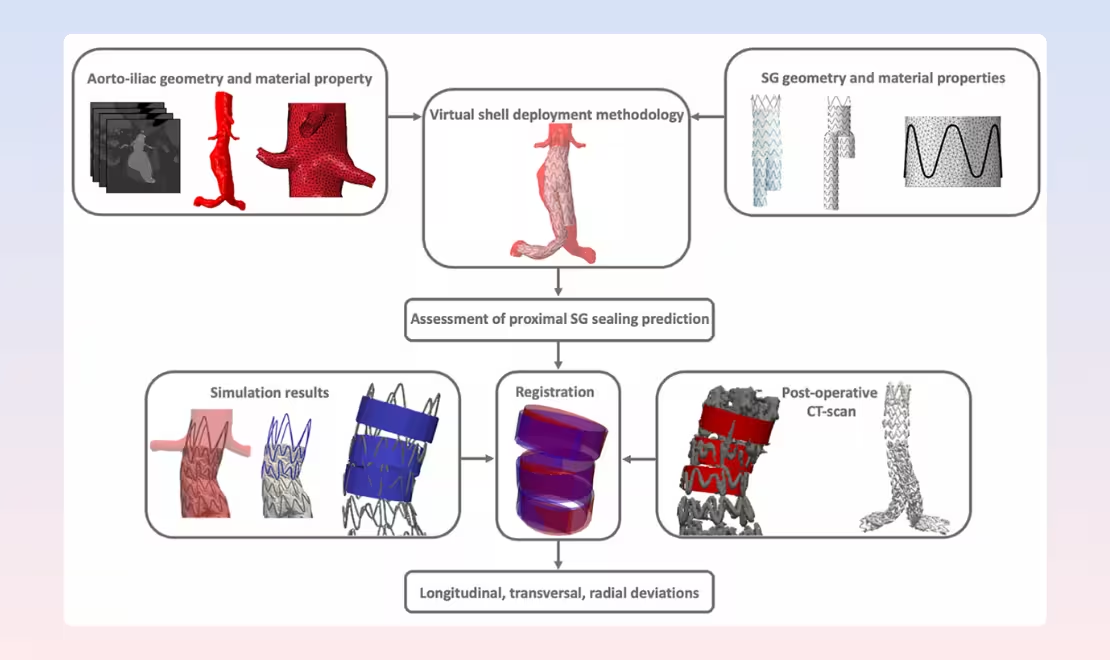
We simulated the deployment of stent grafts in each aorta by solving mechanical equilibrium with a virtual shell method. Eventually we compared the actual stent ring positions from post-operative computed-tomography-scans with the predicted simulated positions.
Results

A successful deployment simulation could be performed for each patient. Relative radial, transverse and longitudinal deviations were 6.3 ± 4.4%, 2.5 ± 0.9 mm and 1.4 ± 1.1 mm, respectively.
Conclusions

The numerical model predicted accurately stent-graft positions in the aortic neck of 10 patients, even in complex anatomies. This shows the potential of computer simulation to anticipate possible proximal endoleak complications before EVAR interventions.