Research Publications
|
PlanOp iSizing
Fully automated segmentation including lumen, thrombus and calcification.
Jan 2, 2026
|
3 min
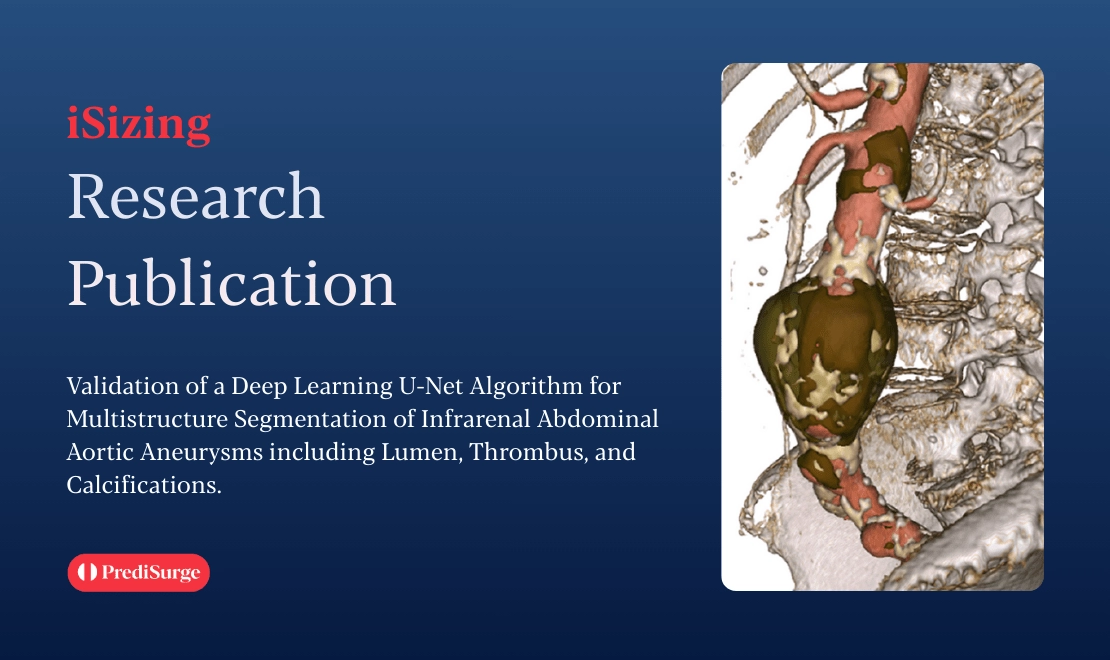
Highlights
- Convolutional neural network (CNN) became the medical image segmentation reference.
- The CNN provided accurate segmentation of arterial lumen, thrombus and calcification.
- Correct automatic detection of 86% of the main collateral arteries was achieved.
- Fully automatic complex aortoiliac segmentation is feasible and accurate.
Objective
- Artificial intelligence and digital twin technologies provide a new way to plan endovascular interventions and can help practitioners anticipate complications. The accuracy of these methods is based on reliable automated aortic segmentation, including intraluminal thrombus (ILT), calcifications, and detection of collateral arteries. The aim of this study was to validate a new fully automated deep learning based aortic segmentation algorithm that could be used for optimised digital twin generation.
Methods
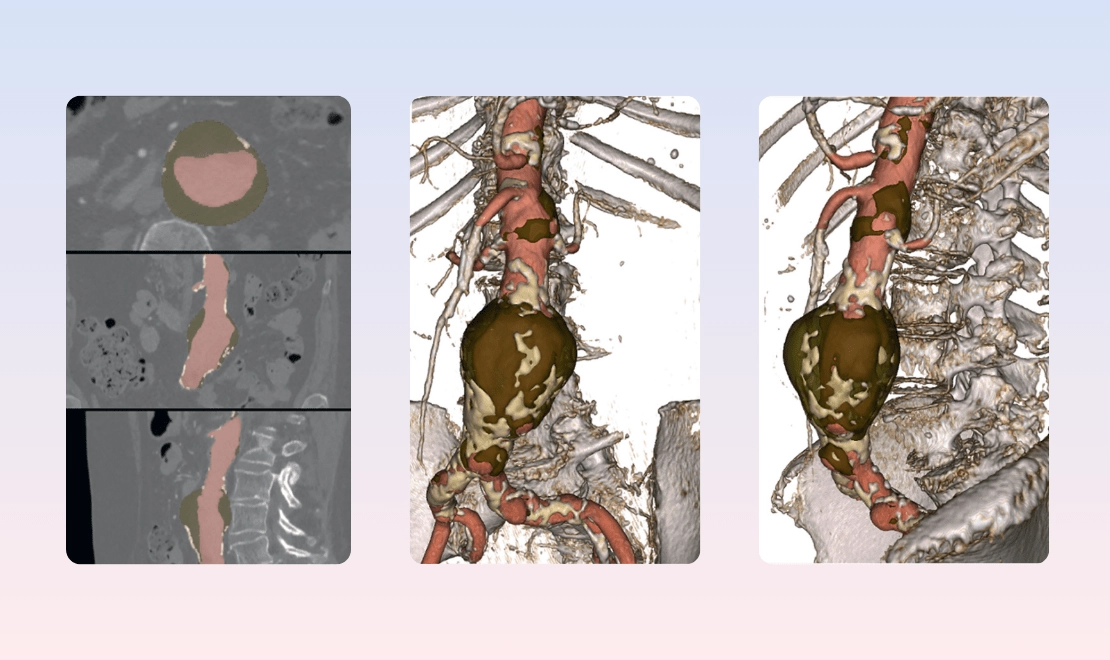
- After training on 1280 computed tomography angiography scans, including 1000 for pre-training and 280 for fine tuning, a convolutional neural network based on a U-Net architecture was externally validated on 48 computed tomography angiography scans to segment lumen, collateral arteries, ILT, and parietal calcifications of the abdominal aorta and iliac arteries. Blinded, manually corrected segmentations from a senior radiologist and surgeon were performed to create the ground truth comparison.
Results
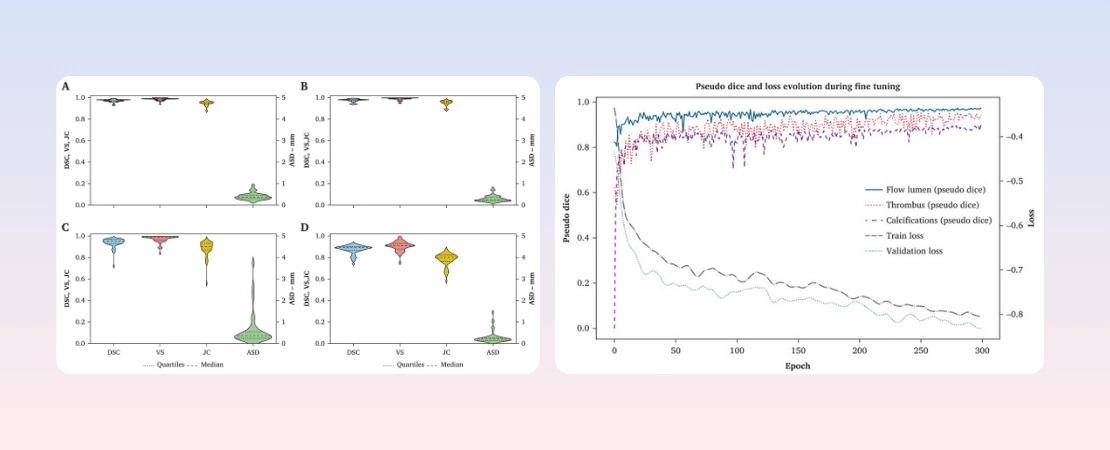
- The comparison between fully automated and manually corrected segmentation methods revealed a mean dice similarity coefficient of 0.97 ± 0.01, 0.94 ± 0.05, and 0.87 ± 0.04 for aortic lumen, ILT, and calcifications, respectively. Average surface distance was 0.30 ± 0.15, 0.61 ± 0.72, and 0.28 ± 0.28 mm for aortic lumen, ILT, and calcifications, respectively. Mean segmentation time was four minutes and 20 seconds with the fully automated method.
Conclusion
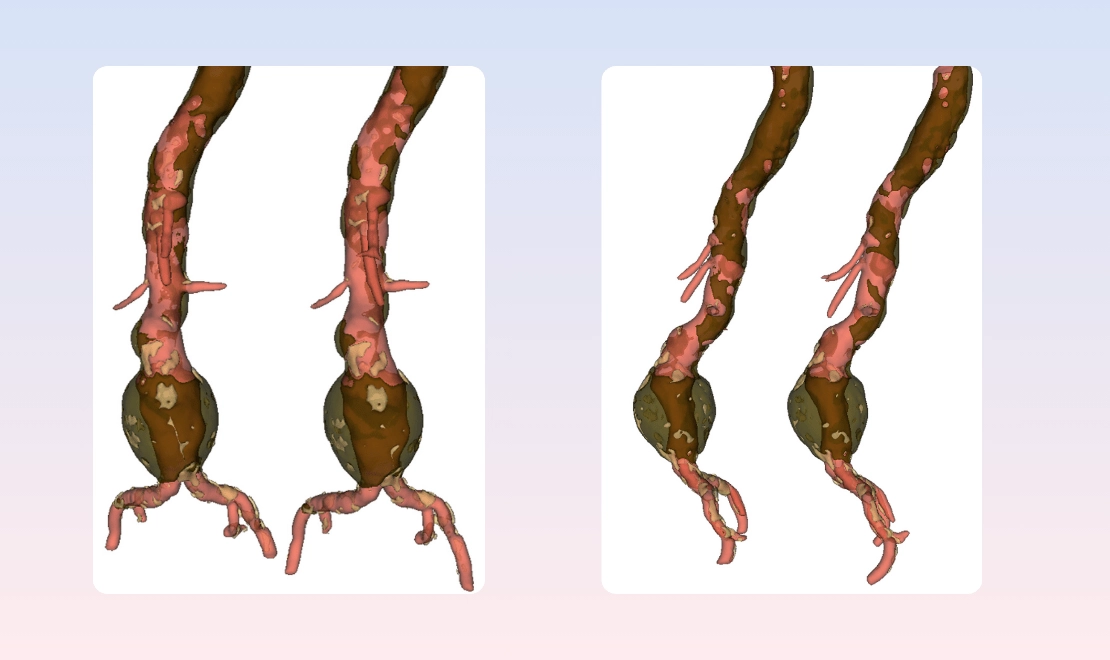
- The deep learning algorithm developed in this study provided valid, fast, and accurate aorto-iliac segmentation. This may be used to automatically generate reliable aortic digital twins for endovascular aortic repair planning.
Read the full article " Validation of a deep learning U-Net Algorithm for multistructure segmentation of infrarenal abdominal aortice aneurysms including flow lumne, thrombus, and calcifications.